Singapore GST: The Complete Compliance & Strategy Guide for Global Founders
-
Ann Vo
Expanding your business into Singapore gives you access to a premier regional financial hub, top-tier infrastructure, and a competitive 17% corporate tax rate. However, navigating GST compliance for foreign companies in Singapore can quickly turn into a costly compliance headache for international entrepreneurs, tech startups, and e-commerce companies.
Whether you are scaling sales into Southeast Asia or structuring a foreign-owned holding entity, understanding what is GST in Singapore, identifying your GST registration threshold in Singapore, and ensuring accurate quarterly GST filing in Singapore are essential to protecting your margins and avoiding steep IRAS (Inland Revenue Authority of Singapore) penalties.
This definitive guide breaks down every aspect of Singapore GST—from mandatory thresholds to voluntary strategy—so you can stay fully compliant while maximizing tax recovery.
1. What is GST in Singapore?
The Goods and Services Tax (GST) is a broad-based consumption tax levied on the import of goods into Singapore as well as nearly all domestic supplies of goods and services. It is equivalent to the Value Added Tax (VAT) used across Europe and Latin America.
2. Current GST Rate Singapore
The GST rate in Singapore is 9%.
The 4 Supply Categories
IRAS classifies all business supplies into four distinct categories:
|
Supply Category |
Applied GST Rate |
Input Tax Recoverable? |
Examples |
|
Standard-Rated |
9% |
Yes |
Domestic sales of goods, local SaaS subscriptions, local consulting services. |
|
Zero-Rated |
0% |
Yes |
Exported physical goods, international cross-border services. |
|
Exempt Supplies |
Non-taxable |
No |
Sale/lease of residential properties, financial services. |
|
Out-of-Scope |
Outside GST regime |
No |
Third-country sales (goods moving strictly outside Singapore), private transactions. |
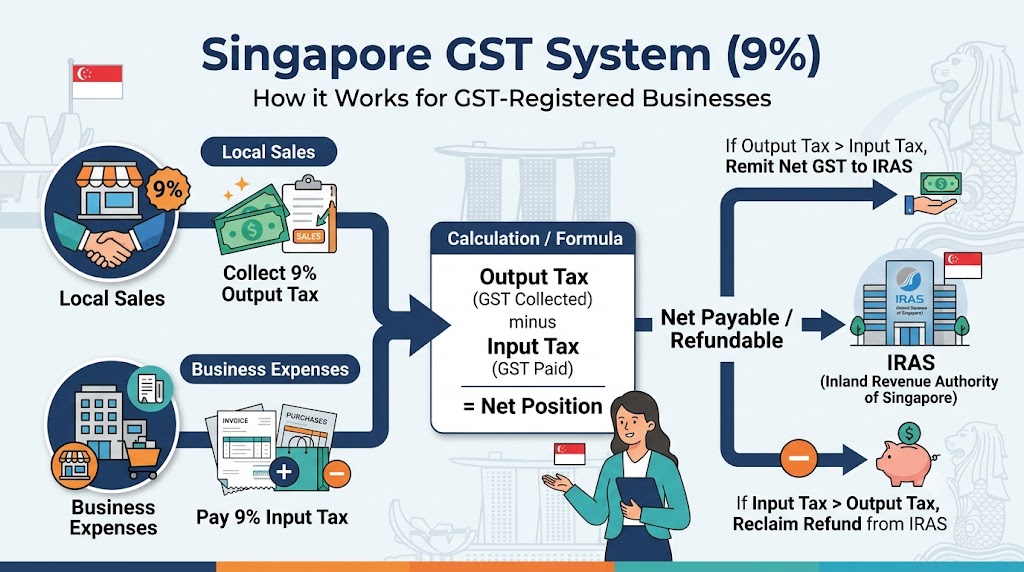
How It Works: Net GST in Singapore is the net tax difference that a GST-registered business must remit to (or be refunded by) the Inland Revenue Authority of Singapore (IRAS) at the end of each accounting period.
Net GST Formula
Net GST=Output Tax (GST Collected)-Input Tax (GSTPaid)
-
- Output Tax: The 9% GST collected by the business from customers on local sales of goods or services.
- Input Tax: The GST paid by the business to suppliers or on imported goods for business operations.
Possible Outcomes:
-
- Positive Net GST (OutputTax>InputTax): The business must pay the net difference to IRAS.
-
- Negative Net GST (InputTax>OutputTax): The business receives a refund for the excess amount from IRAS (commonly seen in export-focused companies or businesses with major capital investments).
3. Do You Need to Register for GST in Singapore?
The question "do I need to register for gst singapore" depends on your annual taxable turnover.
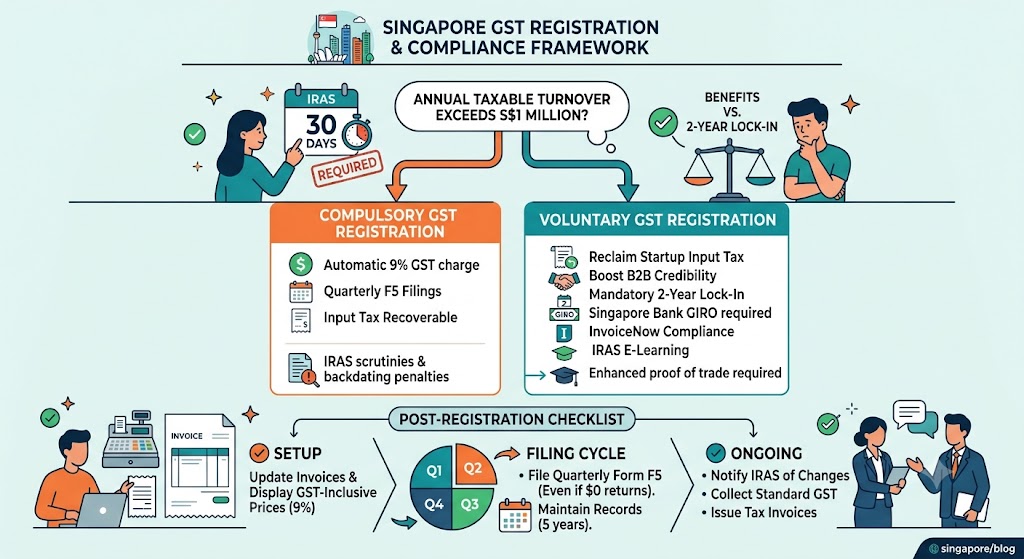
Under Singapore’s Goods and Services Tax (GST) framework, registration is split into Compulsory and Voluntary categories:
Compulsory GST Registration Singapore
You are legally required to register for GST in Singapore under two tests:
- Retrospective Basis: Your total taxable turnover at the end of any calendar year (ending Dec 31) exceeds S$1 million.
- Or Prospective Basis: You have reasonable grounds to expect that your taxable turnover will exceed S$1 million in the next 12 consecutive months (e.g., executing a major enterprise contract).
- Filing Window: When you hit the GST registration threshold in Singapore, you must submit your GST application in Singapore within 30 days. Failure to register on time results in retroactive GST liabilities backdated to your mandatory registration date, plus fines up to S$10,000 and 10% penalties.
Voluntary GST Registration Singapore
You can register for GST Voluntarily in Singapore if your business does not meet the mandatory S$1 million threshold, including scenarios where your company has not yet started operations or making taxable supplies, provided you have a clear intention to make taxable supplies in the future.
Benefits of GST Registration Singapore
- Full Input Tax Refunds: Reclaim 9% GST paid on startup capital expenses, tech infrastructure, office leases, and vendor invoices.
- B2B Credibility: Signaling to multinational partners and corporate clients that your business operates at scale.
- Level Playing Field: Neutralize cost disparities when dealing primarily with other GST-registered vendors.
Key Trade-offs & Requirements
- 2-Year Minimum Commitment: Once registered voluntarily, you must remain registered for at least 2 years.
- Mandatory GIRO Setup: Tax payments and refunds must be processed through a Singapore corporate bank account via GIRO.
- Digital Invoicing: Compliance with IRAS's InvoiceNow network requirement for e-invoicing.
- Director Training: Completion of the IRAS e-Learning course on GST basics prior to submission.
If I do not want to register GST in Singapore, are there any Exemptions?
Even if your revenue exceeds S$1 million, you can apply for an exemption from GST registration in Singapore if more than 90% of your total taxable supplies consist of zero-rated exports or international services. Since zero-rated supplies are taxed at 0%, a registered business in this position would constantly be in a net-refund state—claiming back input tax on purchases while collecting zero output tax on sales. Granting the exemption saves both the business and IRAS the heavy administrative overhead of filing regular GST returns that only result in tax refunds.
Note: If IRAS grants this exemption, you are not allowed to charge GST on any local sales, nor can you claim input tax on your business expenses unless you meet other specific concessionary rules.
4. Singapore GST for E-Commerce, Overseas Vendors & Foreign Ownership
GST for Foreign-Owned Singapore Company
If you incorporate a Singapore entity with 100% foreign ownership, your GST liability rules remain identical to locally-owned firms. However, IRAS subjects foreign-owned entities applying for voluntary registration to heightened scrutiny regarding proof of business intent (e.g., signed agreements, verified local bank accounts, or supplier invoices).
Overseas Vendor GST Registration Singapore & E-Commerce Rules
Singapore mandates GST collection on cross-border digital and physical transactions under two primary frameworks:
Overseas Vendor Registration (OVR) Scheme:
Overseas entities and B2C digital platforms that sell digital services or low-value goods (valued at S1 million and their local B2C sales exceed S$100,000.
Reverse Charge Mechanism for B2B:
Singapore GST-registered businesses importing services or low-value goods from overseas providers must self-account for GST via the Reverse Charge mechanism if they generate non-taxable (exempt) supplies.
5. How to Register GST & File GST Returns
How to Register for GST in Singapore
- Prepare Documentation: Compile corporate profile details, director identities, financial statements/forecasts, and signed client contracts or purchase orders.
- Complete Director E-Learning: Mandatory for voluntary registrants to ensure full understanding of tax obligations.
- Submit via myTax Portal: File the GST application online using Singapore CorpPass credentials.
- Setup GIRO Mandate: Link your Singapore corporate bank account for automated collections and tax refunds.
GST Filing Deadlines & Compliance Cycles
GST reporting is typically conducted on a quarterly filing cycle.
|
Accounting Quarter |
Period Covered |
GST Filing Deadline in Singapore |
|
Q1 |
Jan 1 – Mar 31 |
April 30 |
|
Q2 |
Apr 1 – Jun 31 |
July 31 |
|
Q3 |
Jul 1 – Sep 30 |
October 31 |
|
Q4 |
Oct 1 – Dec 31 |
January 31 |
Critical Rule: You must file an electronic GST Return Filing (Form F5) within 1 month following the end of each accounting quarter. If no transactions occurred, you must submit a NIL return. Late filings trigger an automatic S$200 penalty per month.
6. GST vs. No GST in Singapore
If you do not fall under compulsory GST registration (your taxable turnover is under S$1 million) or if you qualify for a GST exemption (over 90% of your sales are zero-rated exports), you have two distinct paths forward:
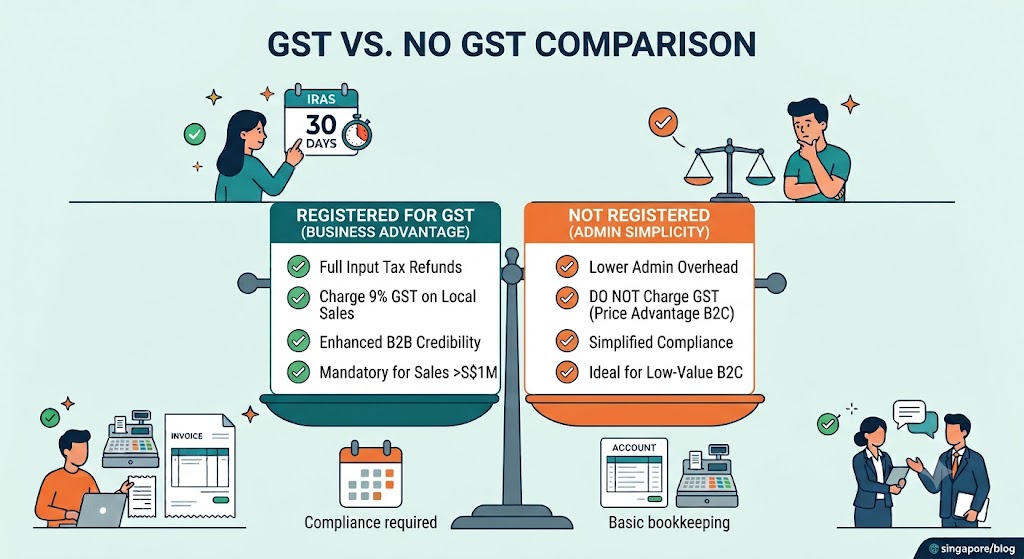
Choose Voluntary GST Registration If:
- Your clients are primarily B2B: Your customers are primarily GST-registered businesses. They can reclaim the 9% GST you charge them, meaning it does not increase their actual costs, while making your business look more established.
- You run an export-driven business: You export goods or provide international services (which qualify for a 0% GST rate). Because you are registered, you can recover 100% of the input GST you paid to your local Singaporean suppliers for raw materials, rent, or utilities.
- You face high initial setup costs: You are making heavy upfront investments (e.g., commercial lease, machinery, fleet, IT infrastructure) and want to recover the GST paid on these expenses. Registering allows you to get a cash refund on all that upfront GST.
- You want to project a premium corporate image: Registration signals to the market that your business turnover is substantial or operating at a corporate tier.
Choose Not to Register / Seek GST Exemption If:
- Your clients are B2C end-consumers: You sell directly to local end-consumers (B2C) or small businesses that are not GST-registered. They cannot reclaim GST. Adding 9% to your retail price will either reduce your competitive edge or force you to absorb the tax out of your own profit margins.
- Your turnover is safely under S$1 million: Your annual taxable turnover is strictly below S$1 million and you want to avoid the increased administrative workload and strict quarterly filing cycles.
- You deal strictly with Exempt or Out-of-Scope Supplies: Your revenue comes entirely from transactions that are excluded from the S$1 million threshold calculation:
- Exempt: Financial services, digital payment tokens, or the sale/lease of residential properties.
- Out-of-Scope: International drop-shipping where the goods never physically enter Singapore.
- You qualify for a full IRAS GST exemption: Even if your retrospective turnover crosses S$1 million, you can apply for a GST registration exemption from IRAS if more than 90% of your total supplies are zero-rated (exports) and you are consistently in a net refundable position.
|
Feature |
GST-Registered Business |
Non-GST-Registered Business |
|
Pricing local sales |
Must add 9% GST to prices (or absorb it). |
Cannot charge GST; price is the final amount. |
|
Business purchases |
Can claim back 9% GST paid to suppliers. |
Must treat GST paid to suppliers as a business cost. |
|
Pricing exports |
Charged at 0% GST (Zero-rated). |
Cannot charge GST. |
|
Filing requirements |
Must file GST returns quarterly via IRAS. |
No GST filings required. |
|
Digital mandate |
Required to use InvoiceNow if registering voluntarily. |
No e-invoicing mandates for GST purposes. |
Optimize Your Singapore GST Compliance Today
Navigating Singapore's tax ecosystem without an expert can lead to unexpected processing delays, rejected applications, or severe penalties from IRAS.
Partnering with a specialized team for GST compliance services in Singapore ensures your registration, quarter-end reconciliation, and cross-border invoicing remain fully aligned with IRAS standards.
- Streamlined GST Application: Fast-track your voluntary or compulsory registration with zero paperwork errors.
- End-to-End Quarterly GST Filing: Professional handling of Form F5 submissions, input tax reconciliation, and InvoiceNow compliance.
- Cross-Border Tax Advisory: Tax optimization for SaaS, e-commerce, and global holding structures expanding across Asia-Pacific.
Here is the revised English FAQ section, seamlessly integrating your exact search phrases and keywords into both the questions and answers:
FAQ: Singapore GST Services
- When must I register for GST Singapore?
You are required to determine when must i register for gst singapore based on two main criteria established by IRAS:
- Retrospective Basis: If your taxable turnover at the end of any calendar year (31 December) exceeds SGD 1 million.
- Prospective Basis: If you have reasonable grounds to expect that your taxable turnover will exceed SGD 1 million in the next 12 months (e.g., supported by signed sales contracts or purchase orders).
- Can I register for GST voluntarily in Singapore?
Yes! Even if the annual turnover has not hit the SGD 1 million threshold, businesses can choose to voluntarily register GST however the timeline and the final decision is on IRAS after reviewing the case.
- What are the GST registration requirements in Singapore?
Key GST registration requirements mandated by IRAS include:
- Demonstrating active business operations or concrete plans to generate taxable supplies in Singapore.
- Completion of the mandatory IRAS e-learning modules ("Overview of GST" and "Registering for GST") by the sole proprietor, partner, or director.
- Fulfilling ongoing compliance obligations, such as quarterly filings and maintaining accounting records for at least 5 years.
- How to register for GST Singapore?
If you are wondering how to register GST, the application is submitted online via the IRAS MyTax Portal. The standard workflow involves:
- Completing the required IRAS e-learning course.
- Gathering corporate profile documents, financial forecasts, and invoices/contracts.
- Submitting the online application for IRAS review, which generally takes 10 to 20 working days.
- How to file GST return in Singapore?
Businesses must complete and submit the GST F5 return electronically through the MyTax Portal on a quarterly basis:
- Calculate your total output tax (GST charged to clients) minus input tax (GST paid to suppliers).
- Submit the filing and pay any net GST due within one month following the end of each accounting quarter.
- What is the GST registration cost in Singapore?
Engaging a corporate service provider or licensed tax agent to prepare and submit the registration on your behalf will incur service fees, the fee is normally calculated based on the workload of the CPA.
The average GST filing service fee in Singapore for professional quarterly reporting typically depends on your transaction volume, accounting complexity, and whether bookkeeping services are bundled in.
Apart from the periodic report fee, you might be required to pay for the GST application fee. The GST registration price in Singapore may vary depending on the service provider. Please contact for more information
- How do I choose the best GST service in Singapore?
Finding the best Singapore GST service comes down to choosing an experienced corporate service provider that offers complete lifecycle support—from initial threshold analysis and IRAS e-learning guidance to application filing and ongoing quarterly GST return compliance.
- What are the rules for voluntary GST registration in Singapore?
Opting for Singapore voluntary GST registration is an effective strategy for startups and expanding businesses to recover input tax on initial capital setup. However, voluntary registrants must stay registered for at least two years, pay via GIRO for GST payments/refunds, and maintain strict compliance with IRAS record-keeping guidelines.
- Is GST registration available for foreign companies in Singapore?
Yes, GST registration for foreign company Singapore is fully permitted for overseas entities conducting business in Singapore. Foreign entities without a local presence can either register directly or appoint a local GST agent in Singapore to handle filings and represent the company before IRAS.
- How to submit GST registration for e-commerce in Singapore?
Specific rules apply regarding gst registration for e-commerce singapore. Cross-border e-commerce businesses selling low-value goods or remote digital services to Singapore non-GST registered customers may fall under the Overseas Vendor Registration (OVR) regime once global turnover exceeds SGD 1 million and Singapore B2C supplies exceed SGD 100,000.